SKU: 70475577612
brown bean succulent

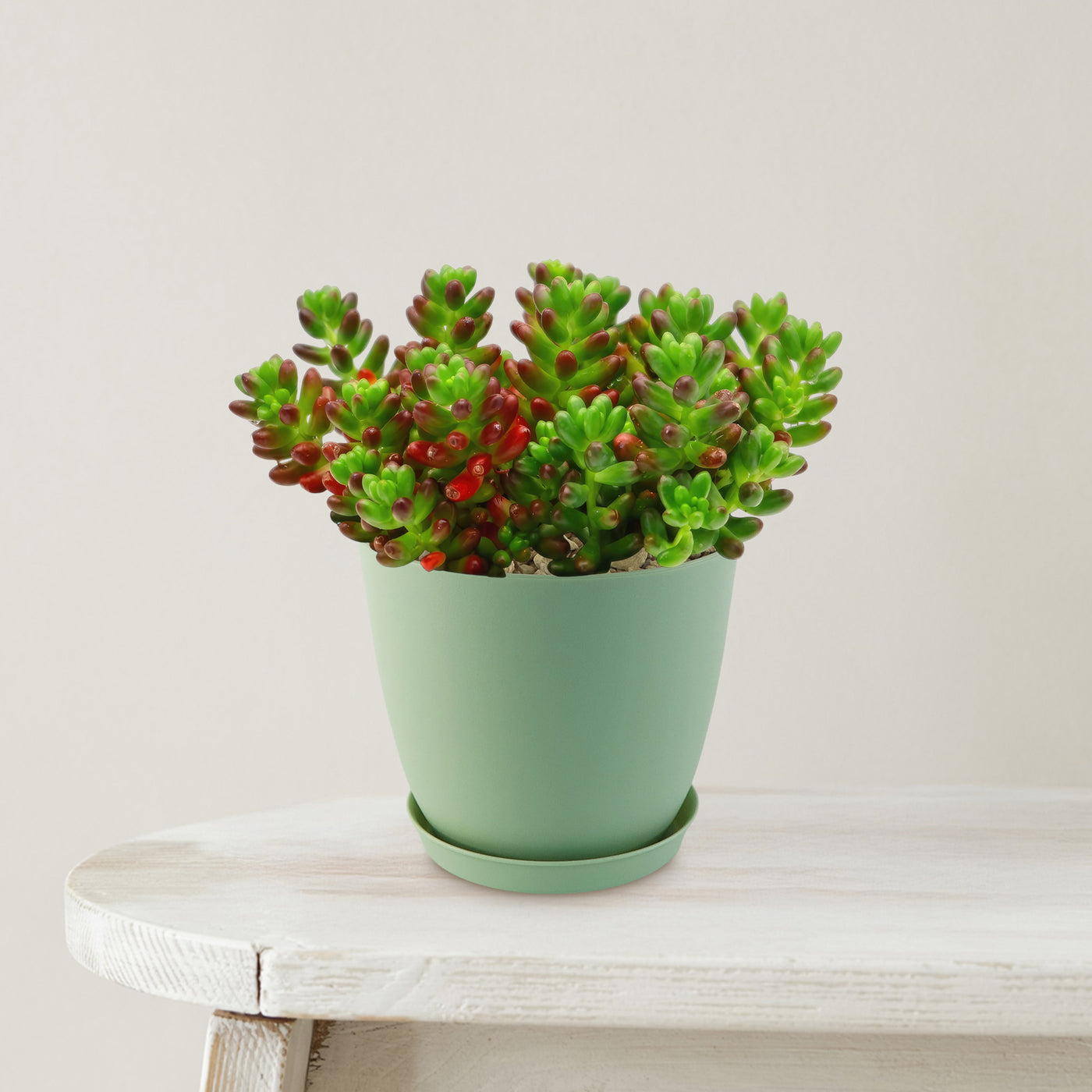
brown bean succulent Jelly Bean Succulent 'Sedum rubrotinctum' 6" Pot / Light Green / With Pot

Sale price$19.29 Regular price$21.43
Save 10%

Shipping Estimate
USA
  • USA
  • CAN

Ships within 48 hours · Estimated delivery Jul 13 - Jul 18

Promo Codes Available:

For Your Every Summer RSVP, with Code: SUMMER15

Description

brown bean succulent Jelly Bean Succulent 'Sedum rubrotinctum' 6" Pot / Light Green / With PotIntroducing the Jelly Bean Plant, botanically known as Sedum rubrotinctum, is a charming, low growing succulent admired for its colorful, bead like foliage. Its cascading stems make it an excellent choice for hanging baskets, window boxes, and container arrangements, where its colorful foliage can spill over the edges beautifully. Native to Mexico, this evergreen perennial is commonly called pork and beans or banana cactus due to its plump, jelly bean

Introducing the Jelly Bean Plant, botanically known as Sedum rubrotinctum, is a charming, low-growing succulent admired for its colorful, bead-like foliage. Its cascading stems make it an excellent choice for hanging baskets, window boxes, and container arrangements, where its colorful foliage can spill over the edges beautifully.

Native to Mexico, this evergreen perennial is commonly called pork and beans or banana cactus due to its plump, jelly bean-shaped leaves that give it a playful and unique appearance.

This hybrid jelly bean succulent has small, fleshy leaves that start out green but develop vibrant shades of red, orange, or bronze when exposed to bright sunlight, making it a standout in any succulent collection.

It is often used as a ground cover in rock gardens or featured in decorative containers and dish gardens.

As the plant matures, Sedum rubrotinctum typically reaches about 8 inches tall and up to 24 inches wide, forming a spreading, trailing habit.

Jelly bean succulent flowers are yellow, small, and star-shaped, blooming in clusters at the tips of their stems.

While the blooms are subtle, they provide a delicate contrast to the bold foliage and usually appear in spring to early summer.

Related Product

What truly makes the jelly bean succulent so popular is its combination of low-maintenance care and vibrant color transformation. It is drought-tolerant, easy to grow, and adapts well to both indoor and outdoor environments with proper light. Its ability to change color with sunlight adds dynamic beauty throughout the year.

When and How to Water Your Sedum rubrotinctum Plant

This jelly bean succulent is highly drought-tolerant and prefers drying out between waterings, making it more resilient to underwatering than overwatering.

The Sedum rubrotinctum should be watered once every 1-2 weeks during the growing season, with light soaking and minimal watering once every 3-4 weeks during the dormant season, with very light moisture.

During the active growing season, allow the soil to dry out completely between waterings. This helps prevent overwatering, which can cause the Sedum rubrotinctum roots to rot.

During the dormant season, your jelly bean requires even less water. It's important to remember that succulents like the jelly bean plant are more tolerant of underwatering than overwatering.

Light Requirements - Where to Place Your Jelly Bean Succulent

When growing indoors, you can grow it in the areas where it can receive atleast at least 6 hours of bright, direct light to maintain their vibrant red coloring and compact, healthy growth. 

Place it near a window that receives plenty of sunlight, but make sure to protect your jelly bean plants from direct exposure to intense sunlight, especially during the hottest parts of the day.

A south or west facing window works best, but protect it from harsh midday sun. If natural light is limited, you can use grow lights. 

When growing outdoors, it loves basking in the full sun, so find a location in your garden or patio that receives at least 6 hours of direct sunlight each day. 

When grown in direct sunlight, the color ranges from bright green leaves to red-tipped leaves, with the brightest hues.  However, it's important to note that the jelly bean plant can also tolerate partially shaded areas, especially in regions with intense summer heat. 

Newly purchased jelly bean succulent may burn if placed in full sun right away, so increase exposure gradually.

  1. If the leaves stretch or turn pale, it needs more light.
  2. If they become scorched or develop brown spots, it is getting too much sun.

Optimal Soil & Fertilizer Needs 

The Sedum rubrotinctum favors very airy, sandy soil that drains well, and NPK fertilizers once a year in spring. Planting your Sedum rubrotinctum in ordinary wet soil will result in compacted roots, stunted growth, and, most likely, root rot. Instead, make or buy a well-draining potting mix, or ideally, use our Go to Soil cactus mix blend 1 gal 4 qt cacti succulent dirt compost growing media that contains organic mycorrhizae to promote the development of a strong root system that helps your jelly bean plants and other succulents to thrive. 

A balanced, low-strength fertilizer works best for your Jelly bean succulent plant, ideally with an NPK ratio around 5-10-5, where phosphorus is slightly higher than nitrogen to support healthy growth. Apply fertilizer once in spring at the start of the growing season to give it a gentle boost to support stronger roots and better nutrient absorption. 

Hardiness Zones & More 

In the United States, this jelly bean succulent is mostly an indoor plant, but if you live in southern Florida or Hawaii, then you can cultivate it outdoors in USDA zones 9-11.

If you live in a colder climate, it's best to bring the jelly bean plant indoors or provide some protection during the winter months.

As for humidity, the jelly bean plant can handle a range of humidity levels, from drier to more humid environments. Just ensure that the soil has good drainage to prevent waterlogged conditions. 

How to Grow as a Houseplant 

Your jelly bean succulent grows best indoors in temperatures between 60°F and 75°F. It can tolerate slightly cooler temperatures during the winter months, but it's best to keep it away from drafts or extreme temperature fluctuations. As for humidity, the Sedum rubrotinctum jelly bean plant can handle average indoor humidity levels, so you don't need to worry too much about providing extra humidity. Just make sure the air isn't too dry, especially during the winter when indoor heating can cause dryness. 

Wildlife - Jelly Bean Succulent Flowers Attract the Following Friendly Pollinators 

Jelly Bean Succulent 'Sedum rubrotinctum' can attract friendly pollinators such as bees, butterflies, hummingbirds, and other beneficial insects. These pollinators play a crucial role in the ecosystem by aiding in the reproduction of plants and ensuring biodiversity.

Butterflies
Bees
Hummingbirds
Lady Bugs
Multi Pollinators
Other Birds

According to ASPCA, the Sedum rubrotinctum is mildly toxic to humans or pets if ingested in large amounts. However, it is safe to touch and handle, making it a popular choice for indoor gardens or landscaping due to its vibrant colors and low maintenance requirements.

How to Propagate Your Sedum rubrotinctum Plant 

To propagate your jelly bean plants, stem or leaf cuttings can be used. Both are simple and have a high success rate. Keep the cutting in a spot with bright, indirect light instead of direct sunlight, and give it some time until you begin to see new growth. 

Key Takeaways

  1. Jelly bean succulents are low-maintenance and drought-tolerant. They prefer infrequent watering and can handle dry conditions better than excess moisture, making them beginner-friendly plants.
  2. 'Sedum rubrotinctum' is known as pork and beans succulent or banana cactus, because of their jelly bean-shaped leaves.
  3. These succulents thrive in airy, sandy soil, and keeping roots from sitting in moisture is key to maintaining plant health.
  4. Jelly bean succulents' leaves shift from green to vibrant red or bronze, in bright sunlight.

Final Thoughts

Overall, the jelly bean succulents (Sedum rubrotinctumm) are captivating succulents with their bean-shaped leaves and trailing growth habit. With their vibrant green foliage and occasional bursts of colorful flowers, they add a touch of whimsy to any space. A succulent tends to live for many years and grows slowly. Plant them in the spring after the weather warms up. Propagating these succulents is relatively easy, whether through stem cuttings or fallen leaves. Jelly bean succulents are a delightful addition to any succulent collection, bringing charm and beauty to both indoor and outdoor settings. If you're looking for a unique and low-maintenance plant, the jelly bean succulent is definitely worth considering!

Don't miss out on this opportunity to add something truly exceptional to your garden. Order your very own jelly bean Sedum rubrotinctum today!
Shipping Notes
  • Free Standard Shipping on $100+ Orders to the USA.
  • Except Preorder products are shipped in 48 hours.
  • Delivery to the USA:
  1. Standard Shipping : 3-10 business days
  • If time is of the essence, please consider selecting expedited delivery for faster service.
Exchange/Return Notes
  • We offer a 30-day return/exchange service after receiving.
  • Final sale items are not eligible for returns or exchanges.
  • To process your return/exchange, please contact us at [email protected]
  • Please click here for more details>>> Return & Exchange Policy
SKU: 70475577612

Discover Niche Categories That Outsell brown bean succulent

Top-Converting Item to Boost Your Average Order

4.0 ★★★★★
Based on 649 reviews
Sort
Highest Rating
Newest First
Oldest First
Product Reviews
G
Verified Purchase
Gary Darling
Waukegan, US
★★★★★ 3
Didn’t last as long as I had hoped
Pants were okay for a returned item, but certainly not the best. They lasted a few months before defects got worse. Probably will convince me to just buy new all the time.
WAS THIS REVIEW HELPFUL?YesReportShare
Reviewed in the United States on December 6, 2025
R
Verified Purchase
Ryan
Carnegie, US
★★★★★ 5
Best Pants I've Ever Owned!!
Size: 44W x 34L Big Tall, Color: Navy Blazer
There is not a bad thing to say about these pants. They look great (I get compliments all the time, as well as people asking for information on them), feel great, are super comfortable, and are actually quite durable. I own these in blue and gray and they are by far my favorite pants to where to work. They work for both business-casual, as well as business-formal dress-codes. Buy these pants!
WAS THIS REVIEW HELPFUL?YesReportShare
Reviewed in the United States on July 27, 2023
L
Verified Purchase
lebowitzit
Carnegie, US
★★★★★ 5
Fits Fine, Looks Great, Sizing Makes No Sense
Size: 16.5" Neck 32"-33" Sleeve, Color: White, Size: 16.5" Neck 32"-33" Sleeve, Color: White
I hate shopping for dress shirts. For me, at least, it is a thoroughly frustrating experience, mostly because there's no consistency at all to the sizing. Actually, that's not quite true: dress shirts consistently DON'T FIT ME PROPERLY, which means I have to look at a lot of shirts and scrutinize size charts - which are usually incomplete, when they're provided at all - before finally finding The One. And sometimes, like this time, I don't manage to find The One. But this shirt comes close, as I will explain. The problem stems from my physique, which I never thought of as unique, but here it is: I'm short (just under 5'4", with a 40-41" chest, a little extra weight (so my middle is about the same), a 36" waist, 33" arms when measured the traditional way (more on that later) and a 16" neck. That last measurement is the single biggest problem: most shirt manufacturers apparently think that if you have a 16' neck, you are shaped like Omar the Tentmaker. Van Heusen is no exception. Note that this shirt is listed as "fitted". Now, that's a completely amorphous descriptor, which, I suppose, is true for most shirt fit descriptors these days. But if you look at Van Heusen's "regular" fit shirts, you'll find that they think if you have a 16" neck, you must have a nearly 50" chest and your waist is over 45". That's not regular, that's freakin' portly! I was afraid to even look at any of their Big & Tall men's dress shirts -- if their idea of regular fit was this skewed, then I didn't want to know what they think Big & Tall is. Thankfully, this is a "fitted" shirt, so Van Heusen thoughtfully provides the 16" neck version with a 42-44" chest and 36-38" waist. That's the size I bought, and it actually fits me pretty well. Still a little loose for a "fitted" shirt, but it doesn't look baggy, and that's what I was after. But a little more realism in the size descriptions would be greatly appreciated. Regarding the sleeve length, I really don't know what's up. I've seen charts that tell you how to measure it, but no matter how I measure it, I never manage to come up with any of the sleeve lengths provided on size charts. I have noticed that there appear to be two ways of measuring it, though. One way, which I call the traditional way because it seems to have been around longer, starts the measurement somewhere between the edge of the shoulder and the neck. At least, I think that's where it starts -- approximately. As I said before, I never manage to come up with the same number. But by this measurement, my correct sleeve length is 32-33", and the average guy's is probably 34-35". In the last year or so, when I shopped for shirts, I found some size charts using a different method, because the numbers were a lot lower, anywhere from 22" to 28". I have no idea where they came up with that measurement, nor do I know what mine is by this method, because the shirts I ended up buying so far have all used what I referred to as the traditional method. Anyway, the shirt looked quite nice on me, right out of the package, and continues to look quite nice on me after a couple of washings. The photo I attached is what the shirt looked like after being washed twice. I wash my shirts on my machine's Delicate cycle and hang them to dry. When cared for this way, the shirt does a pretty good job of living up to the listing's claim of wrinkle resistance. It doesn't come out perfectly smooth and crisp, but it looks good enough that I don't feel inclined to iron it. I decided on a poplin shirt because I was shopping for a summer-weight shirt that would breathe well. But poplin shirts proved nonexistent in my local stores, and not all that plentiful online. Poplin shirts listed online with full size charts so I could tell whether or not they might fit me were nearly as hard to find as igloos in the Mojave Desert, and poplin shirts whose size charts indicated that they were available with dimensions that would actually fit me were somewhere between that and hen's teeth. Needless to say, I was thrilled when I found this one. But the composition of poplin appears to be open to some interpretation. I own a few poplin business shirts (which I wear without suits and ties), and upon receiving my new Van Heusen shirts, it seemed to me that my poplin business shirts were lighter and breathed better. But then it occurred to me that shirt manufacturers often treat their material with coatings that improve the luster and crispness of their shirts for display purposes, and such coatings might be why my new shirts felt stiff, heavy and not particularly airy. Not wanting to give up and send the new shirts back, I decided to take a risk and launder them to see if that improved the feel. Thankfully, it did. After two washings, my new shirts are less shiny than delivered (which I'm fine with), a lot less stiff and breathe reasonably well. So... these shirts fit well, look good and feel good. Check, check and check. That means I'm fully satisfied with them, right? Wrong -- I am NOT fully satisfied with them. It's summertime. Summertime where I live is hot and often quite humid. I wanted shirts appropriate for that weather. To me, that has always meant lightweight broadcloth short-sleeve shirts. But it seems that today's Fashion Police have decreed that there is no longer such a thing as a short-sleeve dress shirt. They have decreed that today's well-dressed men must wear heavy cotton, long-sleeve shirts year-round. Well, excuse me for living, but some of us perspire when dressed that way in summer heat. Poplin shirts were presented to me as the compromise between acceptable modern fashion and comfort. Linen shirts were also recommended, but I couldn't find a single linen shirt what didn't have a crinkly, casual finish, much less one that was intended to be worn with a tie. With extreme effort, I found a poplin shirt that fits well, and I bought two of them, but while they are more comfortable in the sticky summer heat than heavy cotton, they are NOT as comfortable as my old short-sleeve dress shirts. I want new short-sleeve dress shirts, dagnab it! But until I successfully identify and locate all those insane Fashion Police, blow up their air conditioners and confine them to a Chicago Summer Simulator (otherwise known as a sauna) for three days in their heavy cotton shirts so that they will once again bless the manufacture of short-sleeve dress shirts, I guess these Van Heusen fitted long-sleeve poplin shirts will have to do.
WAS THIS REVIEW HELPFUL?YesReportShare
Reviewed in the United States on August 30, 2024
T
Verified Purchase
Tom McCartney
Houston, US
★★★★★ 5
Great quality and true to size labeled.
Size: 16.5" Neck 32"-33" Sleeve, Color: White
Top quality shirt at a great price. Sleeve and neck size true to as labeled. Material lightweight, which is perfect. I could not be happier with this purchase.
WAS THIS REVIEW HELPFUL?YesReportShare
Reviewed in the United States on May 22, 2026
C
Verified Purchase
Cut-AWAY
Grantham, US
★★★★★ 4
Top neck button is hard to close!
Size: 18" Neck 32"-33" Sleeve, Color: White
The top neck button is hard to close when you need to wear a necktie, especially if you have arthritis of the fingers like I do! Also, If your neck is a size 18 , it’s a tighter than what I’m used to! Otherwise a great fit and nice material!
WAS THIS REVIEW HELPFUL?YesReportShare
Reviewed in the United States on May 6, 2026

recommand products